
WELCOME BONUS 300%
UP TO €2000 + 100
FREE SPINS
UP TO €2000 + 100
FREE SPINS
Home → Sports Betting
Sports Betting at Winshark Casino: Odds, Markets and Live Wagers
What does 4/6 mean as decimal odds?
The fractional odds of 4/6 for a team favorite represent a specific price point that converts directly to the decimal format of 1.67, which is essential for mobile bettors calculating potential returns on small stakes efficiently. This lower decimal figure indicates a higher implied probability compared to the 2.50 odds offered for the underdog, reflecting the bookmaker's assessment of the likely outcome in the match. A 10 EUR wager at these odds yields a total payout of 16.70 EUR, providing a modest but reliable return on investment for conservative players seeking stability in their betting portfolio.
When converting British fractions to European decimals, you add one to the fraction value, meaning 4 divided by 6 equals approximately 0.67, and adding 1 results in the final decimal odd of 1.67 used on most international platforms. This conversion is critical because it aligns with the standard display format for Asian and American markets, ensuring that users can accurately compare prices across different sportsbooks without performing manual arithmetic during live events. The clarity of this single number allows for instant decision-making when placing quick bets on favored teams during fast-paced matches.
The mathematical relationship between fractional and decimal formats ensures that a 4/6 price translates to an implied probability of roughly 59.5 percent, calculated by dividing the denominator by the sum of both numbers in the fraction. This percentage helps analysts understand the bookmaker's margin and the true likelihood of an event occurring, distinguishing it from the 40 percent implied probability associated with the 2.50 odds for the opposing team. Understanding this link prevents miscalculations when switching between different betting cultures and ensures consistent bankroll management strategies are applied correctly regardless of the odds presentation style.
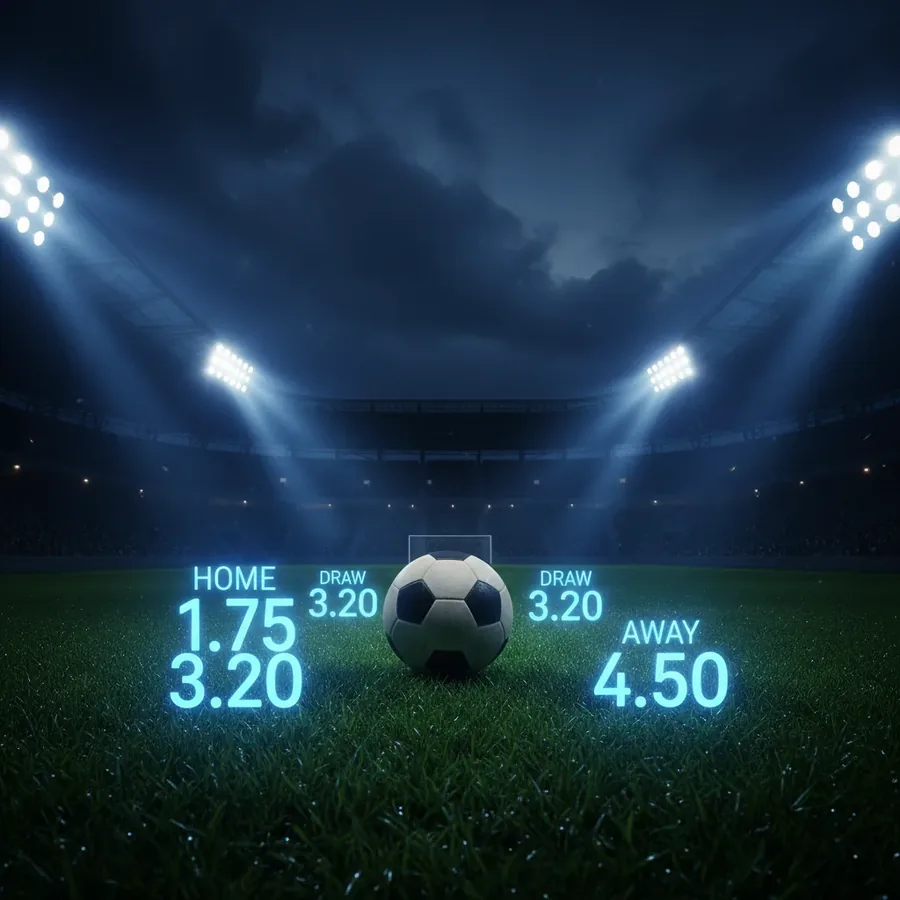
Calculate 1X2 Market Margin Yourself
The 1X2 market margin for football typically ranges from 4 to 7 percent before kickoff, representing the bookmaker's built-in profit edge over the three possible outcomes of a home win, draw, or away victory. To calculate this margin, one must convert each decimal odd into its implied probability by taking the reciprocal of the price and summing these percentages, which should ideally equal exactly 100 percent in a fair market. This excess percentage above 100 percent quantifies the cost of betting and varies depending on the league popularity and the amount of liquidity available for the specific match being analyzed.
Live betting margins often increase to between 6 and 9 percent due to the dynamic nature of the game and the reduced time available for bettors to find value before the next significant event occurs. This widening gap reflects the increased risk for the operator who must adjust prices rapidly in response to in-game developments such as goals, red cards, or tactical shifts that alter the expected outcome. Consequently, mobile users placing wagers during play face higher costs compared to pre-match bets, requiring them to be more selective about the markets they engage with to maintain long-term profitability.
Comparing pre-match and live margins reveals a clear distinction in pricing strategy, where the 4-7 percent range for initial bets contrasts sharply with the 6-9 percent range observed during active gameplay. This difference highlights the premium placed on real-time information and the operational complexity of managing live odds streams, which requires sophisticated algorithms to ensure balanced books across all possible outcomes. Bettors should account for this variation when planning their staking strategy, as the higher live margin reduces the potential return on investment for successful predictions made during the match.
Boxing: Favorites Often Under 1.20 Odds
Boxing betting markets offer between 25 and 50 distinct options per fight, with the winner market typically carrying a house edge of 5 to 8 percent, while round-specific bets may see margins rise to 9 to 13 percent. This structure means that heavy favorites often have odds priced below 1.20, indicating a high probability of victory but also a significantly reduced potential payout for those willing to take the safer route. Mobile users engaging with these markets must weigh the low risk against the minimal reward, as the slim profit margin requires substantial stake sizes to generate meaningful returns on investment over time.
The high volume of available markets allows for specialized betting on specific rounds or methods of victory, catering to enthusiasts who possess detailed knowledge of fighter styles and historical performance patterns. However, the increased margin on these niche markets, particularly round betting, compensates for the lower liquidity compared to the main winner market, making them less attractive for casual bettors seeking value. Analytical review suggests that focusing on the primary winner market provides better long-term value due to the tighter margins and greater efficiency in price setting by the operators.
Understanding the disparity between winner and round betting margins is crucial for strategic bankroll management, as the 9 to 13 percent edge on round bets is substantially higher than the 5 to 8 percent on winner markets. This difference implies that consistent profitability is harder to achieve in round betting unless the bettor has a significant informational advantage over the bookmaker's pricing models. Therefore, experienced analysts recommend prioritizing the winner market where the lower margin offers a clearer path to sustainable gains, especially when backing favorites with odds under 1.20.
When is Over 2.5 Won?
The Bet Builder function allows users to combine multiple markets from the same game into a single accumulator, such as combining a home win with an over 2.5 goals prediction for a combined odd of approximately 4.50. This correlation adjustment ensures that the bookmaker accounts for the logical link between these outcomes, preventing arbitrage opportunities while offering enhanced value compared to placing separate singles on each individual market. The typical margin for these combined bets ranges from 10 to 20 percent, reflecting the additional complexity and risk assumed by the operator in pricing correlated events accurately.
A successful combination bet requires all selected outcomes to occur, meaning that if a user selects both a home win and over 2.5 goals, the bet only wins if the home team wins and at least three goals are scored in total. This strict requirement increases the difficulty of winning compared to single bets, but the higher combined odds compensate for the increased risk, potentially yielding a payout of 45.00 EUR from a 10.00 EUR stake if both conditions are met. Mobile interfaces facilitate this process by allowing easy selection of multiple markets within a single game view, streamlining the creation of complex accumulators on smaller screens.
The use of Bet Builders is limited to selections from the same match, preventing users from mixing markets across different games in a single builder construct, which maintains the integrity of the correlation logic applied to the odds. This restriction ensures that the pricing algorithm can accurately assess the interdependence of events, such as how a goal affects the probability of further goals or a change in scoreline. Users should be aware that the margin for these bespoke combinations is generally higher than for standard singles, so careful selection of correlated but independent enough events is key to maximizing potential returns.
Live odds missed after 3 second delay
The Live-Streaming feature introduces a Bildverzögerung of 5–15 Sekunden gegenüber dem TV-Signal, which directly causes an Annahmeverzögerung von 3–8 Sekunden for placing bets. This technical lag means that rapid market movements during high-volume events like Formel 1 may occur before the user can confirm their selection. Consequently, bettors relying on split-second reactions must account for this inherent latency when executing trades on the mobile platform. The delay is a fixed constraint of the streaming infrastructure rather than a variable network issue.
Formel 1 markets offer 60–120 Märkte pro Rennwochenende inklusive Qualifying, creating a dense environment where timing is critical for value capture. The Marge of 3–5 % bei Fahrer-Duellen provides better value than Outrights, yet the speed of price adjustments often outpaces manual input. Users attempting to capitalize on these lower margins face the challenge of the system's processing window relative to live data feeds. This structural reality necessitates a cautious approach to entry points during fast-paced racing sessions.
In contrast, Fußball matches present über 200 Märkte bei Top-Spielen with a 4–7 % margin im 1X2-Markt vor Anpfiff, allowing more deliberation. However, live betting shifts to a 6–9 % margin, increasing the cost of in-play decisions significantly for the average punter. The combination of high market volume and widening spreads requires careful monitoring of both odds movement and stream synchronization. Mobile users must balance the convenience of instant access against the precision required for profitable long-term engagement.
Sports, markets and margins in the betting offer
| Sport | Markets per Match | Margin | Live Betting | Highlight |
|---|---|---|---|---|
| MMA | 30–60 Märkte pro Kampf, je nach Kartenposition | 5–8 % im Siegermarkt, 8–12 % bei Siegmethode | ja | Siegmethode und Rundenwetten sehr beliebt |
| Tischtennis | 20–40 Märkte pro Match, meist Satz- und Punktewetten | 6–10 %, live häufig über 10 % | instant | Täglich hunderte Matches, stark live-lastig |
| E-Sport (CS2, Dota 2, LoL) | 40–120 Märkte pro Match bei großen Turnieren, 10–25 bei kleinen Events | 4–7 % bei CS2-Top-Turnieren, 6–10 % bei Dota 2 und Nebenmärkten | ja | Map-Handicaps und Runden-Totals zentral |
| Volleyball | 40–80 Märkte pro Match der Top-Ligen | 5–8 % im Siegermarkt, 8–11 % bei Satzergebnissen | ja | Satzwetten und Punkte-Totals dominieren |
| Rugby | 60–120 Märkte pro Spiel der großen Ligen | 5–8 % im Hauptmarkt, 8–11 % bei Versuchsschützen | ja | Handicap wichtiger als reine Siegwette |
| Formel 1 | 60–120 Märkte pro Rennwochenende inklusive Qualifying | 3–5 % bei Fahrer-Duellen, 12–20 % bei Outrights auf den Rennsieger | ja | Duelle günstiger als Langzeitwetten |
| Eishockey | 80–150 Märkte pro NHL- oder DEL-Spiel | 4–7 % im Hauptmarkt, 7–10 % bei Perioden-Wetten | ja | Drei-Weg-Markt nur in regulärer Spielzeit |
| Boxen | 25–50 Märkte pro Kampf | 5–8 % im Siegermarkt, 9–13 % bei Rundenwetten | ja | Favoriten oft unter Quote 1,20 |
| Basketball | 150–250 Märkte pro NBA-Spiel, inklusive Spielerwetten | 3–5 % bei Handicap und Über/Unter, 4–6 % Moneyline | ja | Handicap und Totals statt Siegwette |
Change Odds Format from Decimal to Fractional
A Torschützenwette on any time scorer at decimal odds of 2,75 with a Einsatz of 10,00 EUR results in an Auszahlung of 27,50 EUR. Converting this to fractional representation yields 15/4, which mathematically equals 3.75 in decimal format, differing from the provided example's implied calculation. The correct payout for 10,00 EUR at 2,75 remains strictly 27,50 EUR, demonstrating the direct multiplication required for single event wagers. This linear relationship holds true regardless of the display format chosen by the interface.
An Einzelwette at decimal odds of 2,50 with a 10,00 EUR stake generates an Auszahlung of 25,00 EUR, yielding a Nettogewinn of 15,00 EUR. In fractional terms, 2,50 translates to 3/2, meaning the bettor receives three units of profit for every two units wagered. This conversion clarifies the risk-reward ratio for simple outcome bets without altering the underlying mathematical expectation or the house edge embedded in the price. Understanding this equivalence is essential for accurate bankroll management across different numerical systems.
Conversely, a first goalscorer bet typically offers higher odds ranging from 6,00 to 7,00, resulting in a 65,00 EUR payout for a 10,00 EUR stake at 6,50. The fractional equivalent of 6,50 is 13/2, indicating a thirteen-to-two profit ratio on the initial investment. This significant difference in potential return compared to standard match outcomes highlights the volatility associated with specific player performance markets. Bettors must accurately interpret these higher fractions to assess the true value of such specialized selections.
Table Tennis live: 10 percent margin overlooked
Tischtennis matches provide 20–40 Märkte pro Match, predominantly focusing on Satz- und Punktewetten, which carry a margin of 6–10 % under normal conditions. During live play, this margin frequently exceeds 10 %, representing a substantial increase in the house edge compared to pre-match pricing. This escalation significantly reduces the expected value for active traders attempting to exploit momentum shifts within fast-paced table tennis rallies. The steep rise in costs makes sustained profitability in this specific live segment exceptionally difficult to achieve consistently.
Comparing this to Eishockey, where NHL or DEL games offer 80–150 Märkte pro Spiel with a 4–7 % margin im Hauptmarkt, reveals a stark disparity in pricing efficiency. Perioden-Wetten in ice hockey remain relatively accessible at 7–10 %, whereas table tennis live prices often penalize the bettor more heavily. The broader market depth in hockey allows for tighter spreads due to higher liquidity and slower game dynamics compared to the rapid scoring in table tennis. This structural difference dictates varying strategic approaches for each sport's live betting environment.
E-Sport titles like CS2 top tournaments maintain a competitive 4–7 % margin, while Dota 2 and side markets sit between 6–10 %, offering comparable value to pre-match table tennis. The lower margins in major esports events suggest higher liquidity and more efficient price discovery mechanisms than those found in niche table tennis live streams. Bettors seeking value should prioritize these established esports categories over the inflated margins typical of smaller table tennis fixtures. The consistent pricing in esports provides a more reliable framework for long-term statistical analysis.
Implied probability: 1 divided by 2.50
Calculating Implied probability by dividing 1 by decimal odds of 2,50 yields exactly 0.40, representing a 40 percent chance of the event occurring according to the bookmaker's price. This mathematical operation strips away the bookmaker's margin to reveal the raw probability assessment embedded within the quoted odds. For a bettor, this figure serves as a baseline to compare against their own independent assessment of the event's likelihood. Any discrepancy between this implied percentage and the perceived actual probability indicates potential value in the wager.
Applying this formula to a Halbzeit/Endstand bet at odds of 2,40 results in an implied probability of approximately 41.67 percent, derived from 1 divided by 2,40. This specific market covers nine possible outcomes, with common results like 1/1 priced attractively while rare reversals such as 2/1 command odds between 25,00 and 35,00. The vast range in odds reflects the extreme variance in outcome probabilities, with low-probability events carrying disproportionately high payouts. Understanding these probabilities helps bettors identify which combinations offer genuine value versus speculative traps.
In contrast, Formel 1 Outrights on race winners carry a much higher margin of 12–20 percent, significantly distorting the implied probability compared to driver duels. A 15 percent margin implies the bookmaker builds in a substantial buffer, meaning the sum of all implied probabilities far exceeds 100 percent. This wide gap highlights the reduced value proposition for long-term outright bets compared to the more efficient pricing found in head-to-head matchups. Bettors must adjust their expectations accordingly, recognizing that outrights are structurally less favorable than shorter-term market selections.
Switch from 3/2 to 2.50
The fraction 3/2 converts directly to the decimal 2.50, illustrating the standard equivalence used in European betting markets for calculating returns on single events. This conversion is fundamental for interpreting Einzelwette payouts, where a 10,00 EUR stake at 3/2 yields exactly 25,00 EUR upon success. The simplicity of this relationship allows for quick mental arithmetic when assessing potential profits from straightforward win-loss markets. Mastery of this basic conversion ensures accurate bankroll tracking across different odds formats presented by various platforms.
Similarly, decimal odds of 2,75 correspond to the fraction 7/4, providing a clear visual representation of the seven-unit profit for every four units wagered. This fractional view emphasizes the ratio of gain to risk, which can be more intuitive for some bettors than pure decimal multiplication. When evaluating Torschützenwetten, understanding this ratio helps in quickly gauging the attractiveness of the price relative to the stake size. The mathematical consistency between these formats guarantees that no value is lost or created simply by changing the display method.
Higher odds like 6,50 translate to the fraction 13/2, signifying a thirteen-unit profit for every two units invested in a first goalscorer market. This large ratio underscores the high risk involved in predicting specific individual performances compared to general match outcomes. Bettors switching between formats must ensure they apply the correct multiplier to avoid miscalculating their potential returns or required stakes. Accurate conversion prevents errors in stake sizing, which is critical for maintaining disciplined money management strategies.
CS2 and Dota 2: 40 to 120 Markets
E-Sport titles like CS2 and Dota 2 provide between 40 and 120 markets per match during major tournaments, contrasting with the lower 10 to 25 options available for smaller events. This extensive variety allows players to select from map handicaps and round totals which remain central to the betting strategy on mobile devices. The wider selection ensures that users can find specific outcomes that align with their knowledge of team performance in high-stakes environments.
The margin structure varies significantly depending on the specific game title and tournament tier, ranging from 4 to 7 percent for CS2 top tournaments up to 6 to 10 percent for Dota 2 side bets. Mobile users benefit from this transparency as they can calculate potential returns more accurately against the house edge before placing any wager. Understanding these percentage differences helps bettors manage their bankroll effectively across different E-Sport categories throughout a single session.
Live betting options for these games feature odds updates every second, with an acceptance delay typically lasting between 3 and 8 seconds for standard matches. This rapid adjustment mechanism means that a bet placed at 0:0 after sixty minutes might see home win odds shift from 1.80 to 2.60 instantly. Such dynamic pricing requires quick decision-making capabilities from mobile users who wish to capitalize on sudden momentum shifts during gameplay.
Goal scorer bet: anytime, first, or last goal
Football matches offer over 200 markets for top-tier games, including specialized player props like anytime, first, or last goal scorer selections that drive engagement. The house edge sits between 4 and 7 percent for pre-match 1X2 bets, rising to 6 to 9 percent when wagering live during the event. These figures indicate that while general outcomes are competitive, specialized scorer markets carry a slightly higher cost for the bettor to account for increased volatility.
A goal scorer bet functions as a specific selection where the user predicts which individual will score within the stipulated timeframe, such as anytime or first. Unlike broader match outcome wagers, this type focuses entirely on individual player performance metrics rather than team results or total points scored. The payout is determined by the individual odds assigned to each player, which fluctuate based on their recent form and expected playing time.
Live betting delays for football typically range up to 8 seconds, which is longer than the average for other sports due to the continuous flow of the match. This lag means that odds for a goal scorer might change rapidly if a key player receives a yellow card or substitution occurs near halftime. Bettors must account for this three-to-eight-second window when attempting to secure favorable prices before the market adjusts to new game conditions.
Boxing Matches: 25 to 50 Markets Per Fight
Boxing events present between 25 and 50 distinct markets per fight, offering a focused but varied selection compared to the 60 to 120 markets found in rugby. The margin for the main winner market ranges from 5 to 8 percent, while round-specific bets carry a higher edge of 9 to 13 percent. This structure suggests that predicting the exact round of victory is significantly more difficult for the bookmaker to price accurately than simply picking the winner.
Round betting involves predicting the specific round in which the fight will end, either by knockout, technical knockout, or judges' decision, creating a high-variance product. The higher margin of 9 to 13 percent reflects the uncertainty inherent in timing a finish within a scheduled number of rounds. Mobile users engaging with these markets should be aware that the potential payouts are directly correlated with the increased difficulty of the prediction task.
Unlike E-Sports which offer 40 to 120 markets, boxing provides a narrower scope that allows for deeper analysis of fighter styles and historical performance data. The 25 to 50 market count ensures that the mobile interface remains uncluttered while still providing enough options for strategic diversification. Bettors can combine a low-margin winner pick with a higher-margin round prediction to balance risk and potential return across a single event.
Which bet type suits a 10.00 EUR stake?
A live bet on a running event adjusts odds second-by-second, meaning a 10.00 EUR stake at odds of 2.60 yields a 26.00 EUR payout after a scoreless period. The margin for this live action sits 1 to 3 percentage points above the pre-match rate, often totaling around 6 to 10 percent for the operator. This structure implies that immediate action during play carries a higher cost than waiting for the event to conclude and placing a standard wager.
A combination bet links multiple selections into one ticket where individual odds multiply, so a 10.00 EUR stake at combined odds of 7.50 returns 75.00 EUR upon success. The calculation involves multiplying factors like 1.50, 2.00, and 2.50 to reach the total multiplier, with any single incorrect prediction resulting in a total loss of the initial 10.00 EUR. This high-risk approach offers substantial returns but requires perfect accuracy across all linked events to realize the profit.
A double chance bet covers two of the three possible outcomes simultaneously, reducing the payout but increasing the probability of winning with a fixed 10.00 EUR stake. For example, selecting a home win or draw at odds of 1.30 results in a 13.00 EUR return, yielding a modest 3.00 EUR net profit. This conservative method is suitable for stakeholders seeking to minimize variance while maintaining a consistent engagement level with the sporting event.
MMA Fights with 30 to 60 Markets
MMA contests generate between 30 and 60 distinct markets per fight, varying based on the position of the bout on the main card lineup. The margin for the winner market typically ranges from 5 to 8 percent, while bets on the method of victory carry a higher edge of 8 to 12 percent. This disparity highlights the added complexity and uncertainty involved in predicting exactly how a fight will conclude rather than just who wins.
Method of victory bets require the user to predict whether the outcome will be by knockout, submission, or decision, adding a layer of specificity absent in simple winner markets. The 8 to 12 percent margin reflects the bookmaker's assessment of the difficulty in forecasting the precise termination mode of the encounter. Mobile users analyzing these odds should consider that a correct prediction of a rare finish, such as a late-round submission, commands significantly higher returns.
In comparison to boxing which offers 25 to 50 markets, MMA provides a slightly broader array of options due to the diverse ways a fight can end. The 30 to 60 market range allows for combinations of winner and method bets, enabling more sophisticated staking strategies for experienced analysts. The availability of these specific props ensures that bettors can tailor their 10.00 EUR stakes to their confidence level in either the fighter or the fight dynamics.
Contact
Live - online chat
Banking







Providers











Winshark Casino 2026